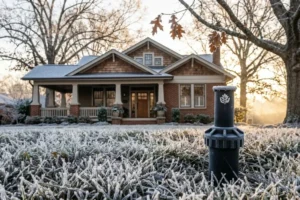
Every year, the first freeze sneaks up on Raleigh homeowners like a cat on a countertop. One cold night, a cracked pipe could be waiting for you in spring.
At Water Works Unlimited, we provide complete irrigation services, including sprinkler winterization to protect systems from freezing temperatures. We recently winterized a large yard in North Raleigh, and the homeowner told us, “I thought turning off the timer was enough.” It is not!
Water trapped inside your irrigation system can freeze, expand, and damage pipes, valves, and sprinkler heads. Here are three steps we include in every winterization to help keep your sprinkler system safe all winter.
What Does Sprinkler Winterization Mean in Raleigh?
Why Freezing Temperatures Cause Trouble
Winterization is the process of getting water out of your sprinkler system before freezing temperatures arrive. Water gets bigger when it turns to ice.
That extra push can crack a pipe, split a fitting, or break a sprinkler head. Central North Carolina does not get a hard freeze every night, but one bad night is all it takes.
When Should You Winterize?
Most Raleigh homeowners should winterize irrigation in late October or November, before the first freeze. We like to book early in the season, since our calendar fills up fast. Waiting for the cold to show up is a risky game.
What Is the First Thing to Add? Shut Off the Water Supply
Turning Off the Main Water
Shutting off the main water to your sprinkler system is step one. Look for the valve near your water meter or where the line enters your home. Turn it off slowly, and do not force it. A stuck valve may need help from a pro.
Why This Step Matters
If the water supply stays on, pressure can damage parts of your system, and more water keeps coming in as you drain. We just helped a customer who thought the water was off. It was not, and the controller kept sending water into a line that was supposed to be empty. Oops!
What Is the Second Thing to Add? Protect the Backflow Preventer
What the Backflow Device Does
The backflow preventer keeps dirty water from flowing backward into your home’s drinking water supply.
It sits above ground, so it is very exposed to the cold. Backflow preventers are among the most delicate parts of your irrigation components, and a failed backflow preventer can be a costly fix.
How We Protect It
Here are the steps we take with every backflow device:
Shut off the water to the assembly, so no new water comes in while we work.
Drain the assembly by opening the test cocks and small valves, so no water is trapped inside.
Add insulation with a cover or wrap, which keeps the cold from reaching the metal.
Remove the backflow and store it indoors in some cases, which is the safest option for very cold weeks.
What Is the Third Thing to Add? Blow Out the Irrigation Lines
How a Blowout Works
A blowout uses compressed air to push water from the system out through the sprinkler heads. We hook an air compressor to the system and work through each of the irrigation zones, one at a time.
Professional winterization uses commercial-grade air compressors because small tools may not move enough air. Too much pressure can hurt the pipes, so the air level must be set with care.
Why a Manual Drain Is Not Always Enough
Some homeowners try a manual drain, using the drain valves at low spots in the pipe. This helps, but it often leaves water behind.
Our crews just did a blowout for a family who tried the manual drain first, and we still got a splash of water out of two zones. Compressed air gets the rest.
What Else Should You Check Before Winter?
Controller and Valve Boxes
Turn your controller to rain mode or off, but do not unplug it. That way, your controller settings stay saved for spring startup. Also check the valve boxes, since leaves and dirt can pile up inside. A little insulation in each box can add extra protection.
Look for Leaks and Broken Heads
Winterization is a good opportunity to identify problems early, and following proper irrigation system winterization procedures helps protect pipes, valves, and sprinkler components from freeze-related damage.
If we spot a leak or broken heads, we can plan spring repairs before the irrigation season starts.
That saves you a headache in April. Spring is also a good time to review how a well-planned lawn irrigation layout saves water and helps your sprinkler system run more efficiently.
Frequently Asked Questions About Irrigation Services
1. Can I winterize my sprinkler system myself?
Yes, some homeowners can drain a few parts by hand. But a full blowout needs the right air compressor and training, so most people call a pro.
2. Is it safe to leave water in the pipes if I do not use them?
No, it is not. Even unused pipes can freeze and crack when water is trapped inside.
3. Do I need spring startup after winterization?
Yes, you do. A spring startup checks your valves, heads, and zones, so your system runs well all season.
Protect Your Landscape Investment This Winter
Shutting off the water, protecting the backflow preventer, and blowing out the lines are the three steps we never skip. Do them right, and you avoid freeze damage and costly spring repairs.
At Water Works Unlimited, we just do this work every fall for homes and businesses across Raleigh, and we love hearing that everything started up perfectly in spring.
Call us today at (919) 570-7808 to book your winterization before the first freeze. We will help protect your sprinkler system so your lawn is ready when warm weather returns.